
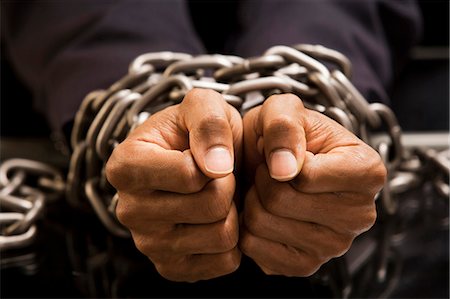
“Man descended from apes, therefore we must love one another.”
Vladimir Solovyov
I love this Solovyov quote. Buried within the sarcasm is the reasoning, of course, that the one does not follow the other. That there’s a difference between our concepts of human rights and ethics as matters of opinion versus them being something that is “self-evident.”
But what are the options if our rights aren’t self-evident? Are they derived from the simple axiom of treating others as you would have them treat you? The survival of the species by mutual agreement that it is better not to harm each other? I could see that point, but it still leaves me with a subjective concept of human value that permits whole societies to do as they wish with those whom they deem “less than human” — or at least, whom the government determines doesn’t meet the criteria for counting.
We’ve seen this throughout history – in the genocide of the Native American and enslavement of the black African; in the rounding up and gassing of Jews in Nazi Germany; in the dehumanizing of the baby in the womb. Humanity’s schizophrenia on the matter is only complicated by this view that many hold without even realizing it — that there is, at the root of it all, no real reason for anyone to take human rights seriously.
This may sound like a bold claim – of course we must take human rights seriously. But why? I suppose we could circle around to the simple answer that we all want our own rights taken seriously – it’s absolutely crucial to our comfort and survival. But really, why should I care for your comfort as long as mine is secure?
On the global stage, even we “innocents” in the West are complicit. We live on goods produced by forced labor of children and “minorities” – if not directly, then at least by partnering with the perpetrators. We certainly don’t have to look far. Our number one business partner is a nation that adheres far more closely to the tenets of secular humanism than we. They’ve rounded up religious minorities and forced them into labor camps. They’ve jailed journalists and lawyers. They’ve forced themselves into previously semi-autonomous cities, installing their own governments and removing monuments to the students they murdered over 30 years ago in the streets of their own capital. And yet, do we have the right ourselves to call them wrong?
We do. We’re right on this because we all [humans] have a unique identifying characteristic that says we are of equal value. The American founders so simply articulated it for us nearly 250 years ago: “We hold these truths to be self-evident, that all men are created equal, that they are endowed by their Creator with certain unalienable Rights, that among these are Life, Liberty and the pursuit of Happiness.”
All of us are created equal and have been given the rights to life, liberty, and the pursuit of happiness by our creator. Help me here, because I can see no way around this. Either we get our rights from something in a way that applies equally to all of us, or we don’t. And if we don’t, then we have little recourse but to allow for what we may ourselves believe to be injustices against humanity because we have no foundation for such beliefs other than our own opinions. And if they’re our opinions we must either respect the opinions of others who feel differently than we, or we must enforce them upon others. There is no moral right in this way. It is simply a matter of having the power to do such a thing. Or, as the saying goes, “might makes right.”
If you think about it though, real life looks to be favoring it that way. While the Nazis were murdering Jews, we did not have the power to stop them until we beat them in 1945. But did that mean they were right up to that point? And right now, although we believe it’s wrong to oppress religious minorities, we do not have the power to stop the oppressors in some countries (some of them even get to hold the Olympics). Does that mean they are right? Again – who’s to say? You? Why?
I ask these questions because I want to make it clear: I believe the murder of the Jews by the Nazis was wrong. I believe the oppression of religious minorities – the oppression of anyone for that matter – is wrong. I believe the murder of babies in the womb is wrong. But not because it’s my opinion that makes it so. It’s because each and every one of the oppressed and murdered have value as ones created in the image of God. A value assigned outside of themselves and against which our opinions have no moral standing.
It is upon this that I can confidently stand when I say that we all have rights. To do otherwise makes no sense.
We could have stopped the murder by Nazis of some of those Jews if we had supported immigration instead of denying visas. Immigration reform and ending the death penalty are 2 human rights issues that get lost behind easier, more glamorous and marketable issues.
I’ve hear the immigration angle, and while of course it seems a good thing, I’ve also warned against “hindsight is 20/20″ism. I would speculate in the context of the times (and this is only speculation) that we had no idea the Nazis were exterminating Jews (or were going to, as I suspect we weren’t denying immigration visas to German citizens while we were actually fighting the war with them (I could be wrong there though too)). So I can’t say that immigration is the issue here as we probably were conducting our immigration policy as usual under the circumstances at the time.
As for the death penalty, I have opposed that for as long as I can remember.
But this clouds my entire purpose here. I’m saying we can’t be against the extermination of the Jews if we don’t have a standard by which their extermination is wrong. And of course we do, but the place from which that standard comes is important. Killing Jews is an extreme and obvious example, but it is also the natural conclusion to which one can come if one believes only in humanity as the final arbiter. Humanity’s definitions change. They vary from region to region — from person to person. Under the human-centered view then, the correct answer for any disagreement on the rights of others is simply, “says who?”
Why do you oppose the death penalty?
This probably goes to, and falls right in line with, the depravity of man — not the ones charged with crimes calling for the death penalty, but for the overzealous prosecution of those people by a depraved people. Our history — even recent history — is filled with examples of people who were convicted but, only through the heroic efforts of some, were spared. I would venture to say that for every one freed, there there are others who not fare so well. There are known cases of people wrongfully convicted and put to death — even if only mistakenly so (not through the nefarious means of the overzealous prosecutor). On a lesser note, there are also cases where the threat of the death penalty is used to pressure suspects into confession in exchange for taking it off the table. As long as any of these possibilities exist, I cannot in good conscience support the death penalty.
On one final note — I don’t know the latest stats, but it is cheaper to sentence a prisoner to life in prison without parole than to sentence them to death.