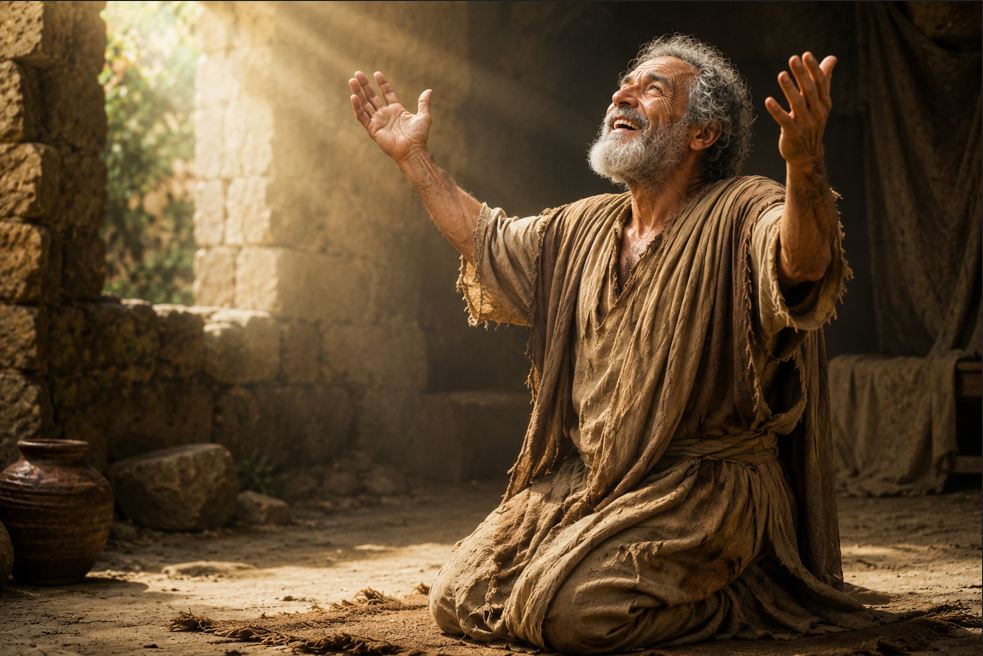
I don’t normally go to the emotions as any kind of proof. I mean, if the foundation upon which you build your faith is true, it doesn’t matter how it makes you feel. But it should matter in other ways. A person’s faith is obviously important; but more importantly, it’s that in which one places their faith that matters most. I mean, the terrorists who flew planes into buildings 25 years ago had incredible faith…in a god whom they believed was fine with flying planes into buildings.
But there’s this – looking at the foundation of the Christian faith, you see history. Tom Schrader (a pastor I first heard on the radio…so you know it was a while back) would say, “Paul was out there showing the other team our playbook.”
He really was:
13 But if there is no resurrection of the dead, then not even Christ has been raised. 14 And if Christ has not been raised, then our preaching is in vain and your faith is in vain. 15 We are even found to be misrepresenting God, because we testified about God that he raised Christ, whom he did not raise if it is true that the dead are not raised. 16 For if the dead are not raised, not even Christ has been raised. 17 And if Christ has not been raised, your faith is futile and you are still in your sins. 18 Then those also who have fallen asleep in Christ have perished. 19 If in Christ we have hope in this life only, we are of all people most to be pitied. (1 Cor 15:13-19).
That’s it. No resurrection, no Christianity. Resurrection? Well, then you can pretty much take everything else as the gospel truth (yeah, I meant to say that). There’s a whole bunch of logic wrapped up in this – one could say, “Well, just because the resurrection is true doesn’t mean we have to believe the rest of the Bible.” I don’t necessarily want to get into that right now. I would simply address that with another passage (in the Bible which those who bring up the argument reject, so I don’t know to what effect): “He has fixed a day on which he will judge the world in righteousness by a man whom he has appointed; and of this he has given assurance to all by raising him from the dead [my emphasis].” (Acts 17:31). Christ’s position as Lord and Savior is established by that to which the Bible in its entirety points. To go even further back – Genesis 1:1: “In the beginning, God created the heavens and the earth.” His creation, his rules.
So back to my thoughts…
It’s only natural that there should be an emotional element behind one’s salvation. One would have to be completely wooden and unemotional to not feel something when confronted with the prospect of eternal life in peace. And this is what crept into my thoughts this morning. There are times I’m swirling in impatience, frustration, and self-pity; and (I’ve written about this before) I can usually associate those times with majoring in the minors – listening too hard to the world around me and not to what’s truly important.
I’ve got this experience — when I put that noise aside and just sit down with my Bible, it all comes back into focus, and I’m left wondering, “Why’d I ever step off the path?” Well…I know why. I’m weak. I’m distracted. I’m human. Not in the way of an excuse, but to say I’ve got this natural tendency to err on the side of me. That’s the problem for all of us, right? Even Paul, who at one time was a real piece of work but was later literally confronted and changed by Jesus himself, said in his letter to the Roman church, “I do not understand my own actions. For I do not do what I want, but I do the very thing I hate…I do not do the good I want, but the evil I do not want is what I keep on doing.” But then he says, “Now if I do what I do not want, it is no longer I who do it, but sin that dwells within me.” The main difference is that Paul recognizes the sin that dwells in him. Most of humanity has a much broader view of that which is allowable and a much narrower view of “the very things [they] hate.”
The thing is, when one works with in an overly broad definition of personally acceptable behaviors, it’s inevitable that they’ll do something they’ll later regret (no matter how cavalier they are when they’re doing it). Probably a lot of things. I look back on what I can remember of my younger years and wish so desperately that I would have believed in Jesus before those things ever happened. Even the small things. But as the saying goes, “There are some things that you just can’t unsee.”
Or undo.
You may forget these things for a time, but who among us hasn’t looked back on something they did and cringed (most of it long forgotten by everyone but you)?
But we are what we are. We did what we did. And still the words of Romans 5 burst through it all when we realize that “God shows his love for us in that while we were still sinners, Christ died for us.”
How can I not let that wash over me and replace the regrets of life, past, present, and future with joy and peace? These are the emotions of belief.